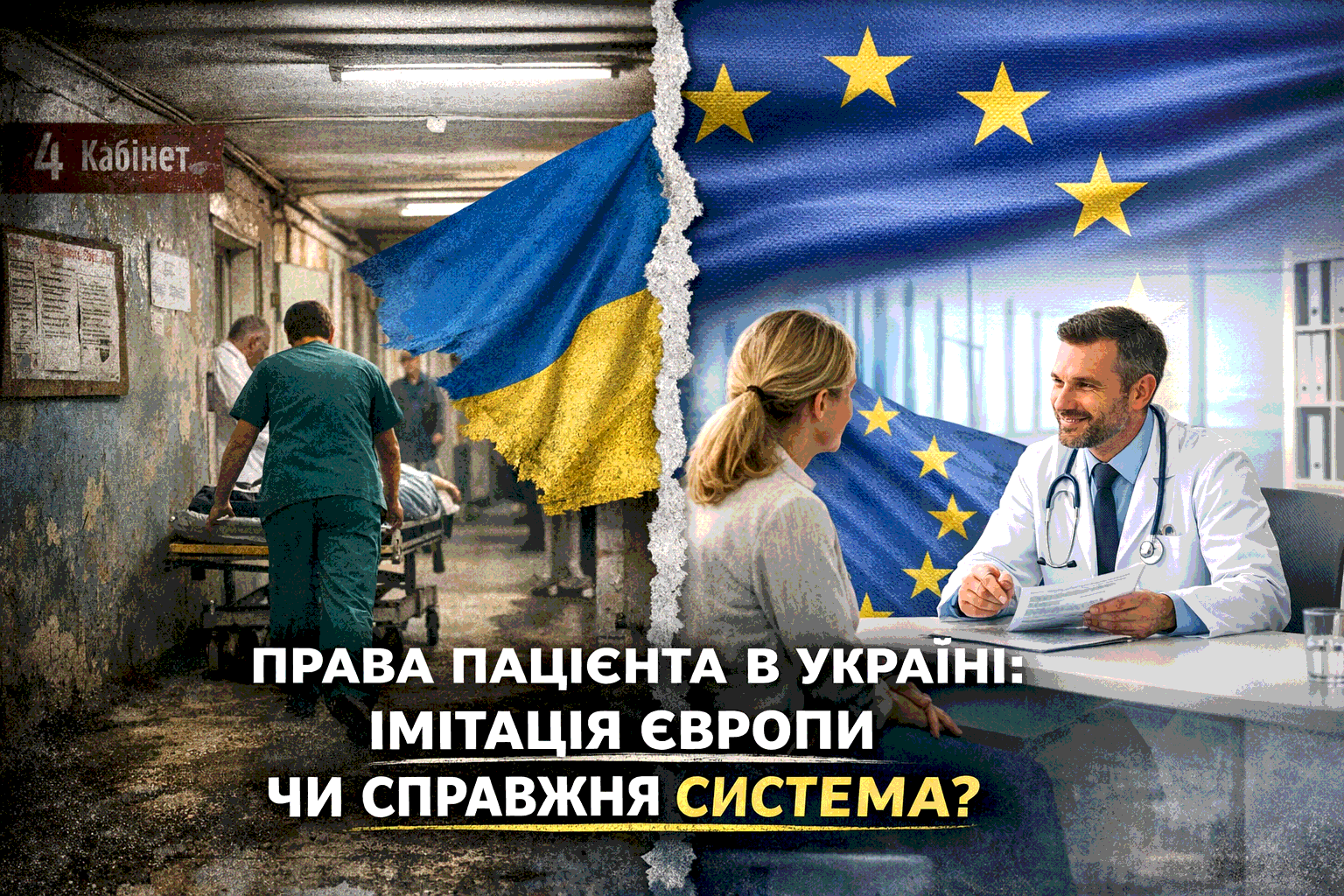
On April 18, Europe talks about patients' rights. This is not just a date or a formal reminder of humanism in medicine. This is a day that refers to a very specific idea: a patient is not an object of treatment, but a subject of the system, a person who has not only a need for help, but also the right to influence decisions, receive full information and be protected. In Europe, this idea has long gone beyond declarations and has become part of the real functioning of the system. In Ukraine, we are still between two realities: we already have texts, but we do not yet have a full-fledged system.
If you open Ukrainian legislation, everything looks quite convincing. The patient's rights are enshrined, they include access to medical care, the right to information, to choose a doctor, to confidentiality. Formally, Ukraine does not look like a country that is lagging behind. But the problem is that the law is only a framework. The system begins where the right can be implemented, protected and defended. And this is where the main gap arises.
In real life, a patient in Ukraine often does not understand what is happening to him, does not receive a full explanation of the treatment, has no real influence on the decision and does not know how to act if his right is violated. The worst thing is not even this, but the fact that he does not have inner confidence that the system is able to protect him at all. And this is no longer a question of individual doctors or hospitals, it is a characteristic of the entire system.
The European approach is fundamentally different. There, patient rights are not a moral norm or a beautiful declaration. They are an operational mechanism. If a right is violated, there is a clear path: a complaint, a review procedure, a decision, responsibility. The patient has access to information not because the doctor “decided to explain”, but because the system is obliged to make this information available. Informed consent is not a signature, but a process. Choosing a doctor is not a formality, but a real option. And most importantly: there is transparency and accountability. The system does not protect itself, it is obliged to work in the interests of the patient.
Ukraine is actively moving towards European integration today, and this is an undeniable fact. The Ministry of Health works with EU directives, undergoes screenings, harmonizes legislation in the field of medicines, medical devices, and cross-border assistance. This is an important and necessary process. But it has one fundamental limitation: it concerns primarily the regulatory field, and not the daily experience of the patient.
You can perfectly harmonize pharmaceutical legislation and at the same time leave a person in a situation where they do not understand what is being done to them in the hospital. You can implement European standards for medical devices, but not change the way of communication between a doctor and a patient. And that is why formal European integration does not guarantee real transformation.
The biggest problem of the Ukrainian system is the lack of an effective mechanism for protecting rights. If a right is violated, the patient does not have a quick, clear and effective response tool. Complaints often remain within institutions, dissolve in bureaucracy or do not lead to real consequences. This creates a very dangerous effect: the system actually protects itself, rather than protecting the person.
Separately, it is worth talking about informed consent, one of the key elements of patient rights. In European practice, this is a process that includes explanations, discussion of alternatives, understanding of risks, and joint decision-making. In Ukrainian reality, this often comes down to signing a document that the patient did not read or understand. Formally, the procedure is completed, but in essence - not. And this is not a minor detail, but a fundamental problem that shows that we often imitate the process without changing its content.
But the deepest difference between Ukraine and Europe is not even in procedures. It is in culture. Ukrainian medicine is still largely built around a model where the doctor is the center and the patient is the object. The European model has long since shifted the emphasis: the doctor is the expert, but the patient is the partner. This is not a question of politeness or empathy. This is a question of the distribution of power in the system. Who has the information? Who makes the decisions? Who is responsible?
If we look honestly, there are several systemic gaps in Ukraine that do not allow us to talk about the full implementation of patient rights. These include the lack of an effective protection mechanism, the formalization of informed consent, limited real choice, a weak culture of patient-centricity, and insufficient integration of rights into the digital system. But another important point: these problems are not insurmountable.
And here is the key idea that often falls out of the public discussion: not everything depends on the state. Some changes can and should be made now. Clinics can build a transparent model of interaction with the patient, provide full access to information, create real mechanisms for considering complaints. Doctors can change their approach - explain, not dictate, involve the patient in decision-making. New medical projects can immediately base themselves on European standards, without waiting for it to become mandatory.
Ukraine today faces a very clear choice. We can continue to move along the path of formal integration, reporting on the implementation of directives and harmonization of legislation. Or we can take a more difficult, but the only right step - to change the very logic of the system.Because true European integration in medicine is not just about compliance with documents, it is about changing the role of the patient.
From the object to the subject.
From the applicant to the rights holder.
From a silent participant to a partner.
And the question today is not whether we know these principles, the question is whether we are ready to make them a reality?
If you open Ukrainian legislation, everything looks quite convincing. The patient's rights are enshrined, they include access to medical care, the right to information, to choose a doctor, to confidentiality. Formally, Ukraine does not look like a country that is lagging behind. But the problem is that the law is only a framework. The system begins where the right can be implemented, protected and defended. And this is where the main gap arises.
In real life, a patient in Ukraine often does not understand what is happening to him, does not receive a full explanation of the treatment, has no real influence on the decision and does not know how to act if his right is violated. The worst thing is not even this, but the fact that he does not have inner confidence that the system is able to protect him at all. And this is no longer a question of individual doctors or hospitals, it is a characteristic of the entire system.
The European approach is fundamentally different. There, patient rights are not a moral norm or a beautiful declaration. They are an operational mechanism. If a right is violated, there is a clear path: a complaint, a review procedure, a decision, responsibility. The patient has access to information not because the doctor “decided to explain”, but because the system is obliged to make this information available. Informed consent is not a signature, but a process. Choosing a doctor is not a formality, but a real option. And most importantly: there is transparency and accountability. The system does not protect itself, it is obliged to work in the interests of the patient.
Ukraine is actively moving towards European integration today, and this is an undeniable fact. The Ministry of Health works with EU directives, undergoes screenings, harmonizes legislation in the field of medicines, medical devices, and cross-border assistance. This is an important and necessary process. But it has one fundamental limitation: it concerns primarily the regulatory field, and not the daily experience of the patient.
You can perfectly harmonize pharmaceutical legislation and at the same time leave a person in a situation where they do not understand what is being done to them in the hospital. You can implement European standards for medical devices, but not change the way of communication between a doctor and a patient. And that is why formal European integration does not guarantee real transformation.
The biggest problem of the Ukrainian system is the lack of an effective mechanism for protecting rights. If a right is violated, the patient does not have a quick, clear and effective response tool. Complaints often remain within institutions, dissolve in bureaucracy or do not lead to real consequences. This creates a very dangerous effect: the system actually protects itself, rather than protecting the person.
Separately, it is worth talking about informed consent, one of the key elements of patient rights. In European practice, this is a process that includes explanations, discussion of alternatives, understanding of risks, and joint decision-making. In Ukrainian reality, this often comes down to signing a document that the patient did not read or understand. Formally, the procedure is completed, but in essence - not. And this is not a minor detail, but a fundamental problem that shows that we often imitate the process without changing its content.
But the deepest difference between Ukraine and Europe is not even in procedures. It is in culture. Ukrainian medicine is still largely built around a model where the doctor is the center and the patient is the object. The European model has long since shifted the emphasis: the doctor is the expert, but the patient is the partner. This is not a question of politeness or empathy. This is a question of the distribution of power in the system. Who has the information? Who makes the decisions? Who is responsible?
If we look honestly, there are several systemic gaps in Ukraine that do not allow us to talk about the full implementation of patient rights. These include the lack of an effective protection mechanism, the formalization of informed consent, limited real choice, a weak culture of patient-centricity, and insufficient integration of rights into the digital system. But another important point: these problems are not insurmountable.
And here is the key idea that often falls out of the public discussion: not everything depends on the state. Some changes can and should be made now. Clinics can build a transparent model of interaction with the patient, provide full access to information, create real mechanisms for considering complaints. Doctors can change their approach - explain, not dictate, involve the patient in decision-making. New medical projects can immediately base themselves on European standards, without waiting for it to become mandatory.
Ukraine today faces a very clear choice. We can continue to move along the path of formal integration, reporting on the implementation of directives and harmonization of legislation. Or we can take a more difficult, but the only right step - to change the very logic of the system.Because true European integration in medicine is not just about compliance with documents, it is about changing the role of the patient.
From the object to the subject.
From the applicant to the rights holder.
From a silent participant to a partner.
And the question today is not whether we know these principles, the question is whether we are ready to make them a reality?