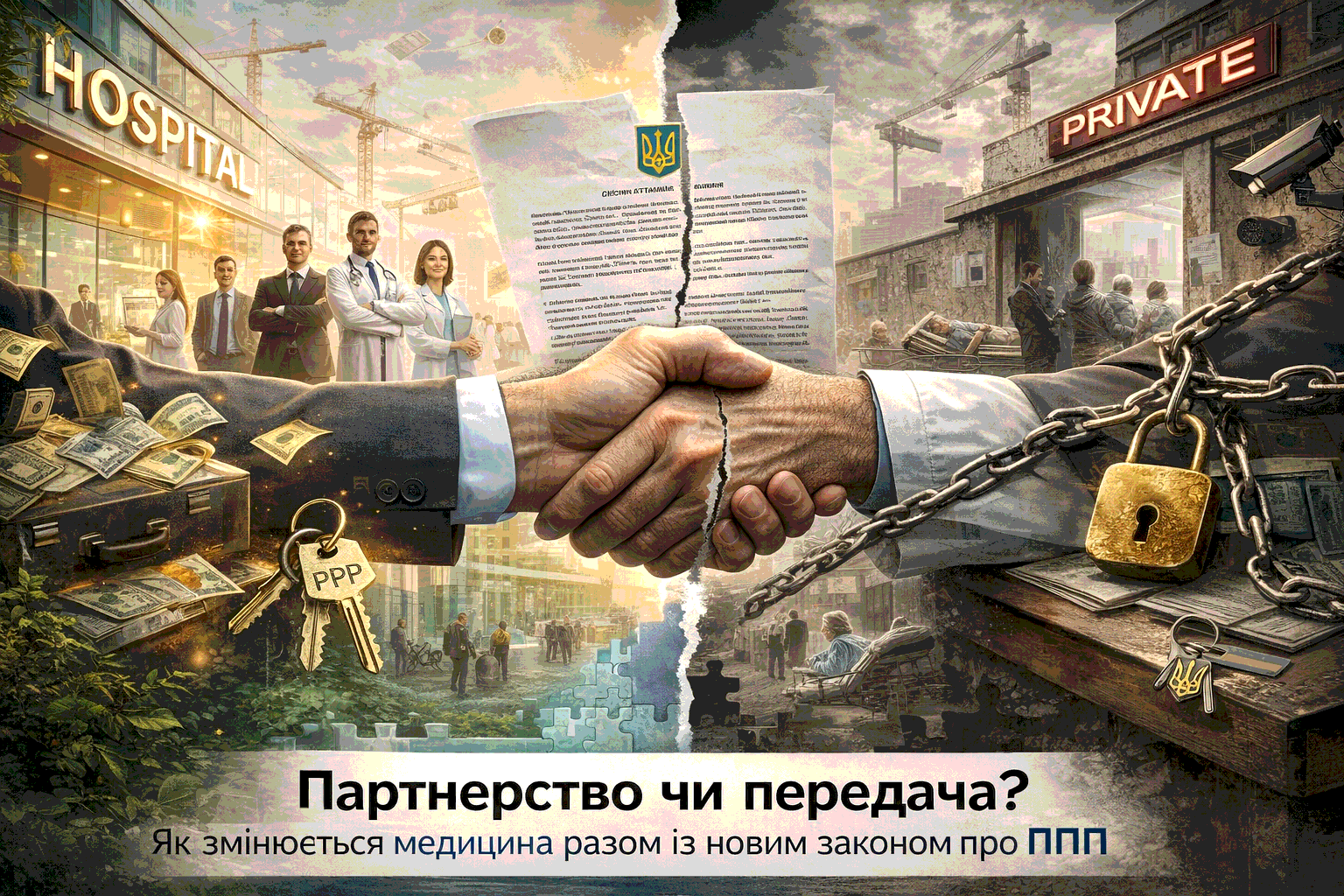
Ukrainian medicine is entering a new phase - not so much of reforms as of rethinking the very model of existence. What a few years ago looked like point experiments is today being formalized into state policy: medicine is being opened up to the systematic participation of private capital.
On October 31, 2025, a new law on public-private partnerships came into force. And it is from this moment that the conversation about PPP ceases to be theoretical. It becomes practical and, at the same time, very sensitive. Because the question is not really whether investments in medicine are needed. They are needed. The question is different: under what conditions and who controls the process?
In the public space, this topic quickly polarized. On the one hand, there are expectations of modernization, new technologies, and managerial efficiency. On the other, there is fear of “hidden privatization” and the loss of free healthcare. As is often the case, the truth lies not between these positions, but deeper - in the details that are not visible at the level of slogans.
The new law truly changes the rules of the game. It does not simply update the previous framework, but expands it to such an extent that medicine becomes a full-fledged object for investment partnership models for the first time. Restrictions on sectors disappear, procedures are simplified, and guarantees of stability appear for the private partner. For the investor, this is a clear signal: the state is ready for long-term cooperation. And here a key tension arises. Because medicine is not an ordinary market. This is an area where the logic of profit always intersects with the logic of access. And these two logics do not always coincide.
Legally, a public-private partnership does not mean privatization. A concession, as one of the forms, involves the transfer of an object to management for a certain period. The ownership formally remains with the state or community. The private partner invests, modernizes, optimizes processes and receives income. But the new legislation adds a nuance that creates the main tension. In certain cases, the transfer of ownership is allowed. And although this is not the basic model, the very possibility of such a transformation changes the perception of the entire instrument. Not because it will automatically lead to privatization. But because now it is a matter of the specific terms of a specific contract.
This is where real politics begins.
The state today is promoting PPP not for ideological reasons. It is a response to resource constraints. The healthcare system is working under the pressure of war, chronic underfunding, staff exhaustion, and dilapidated infrastructure. In this situation, attracting private capital seems not just logical, but almost inevitable. But there is a paradox in this decision. In order to save the system, the state is opening it up to players whose logic differs from the public one. And if this balance is not precisely adjusted, the system will begin to change in places not expected.
The biggest risk is not in the very fact of partnership. It is in how exactly it will be implemented? In reality, the private partner will always be interested in those segments that generate income: diagnostics, planned interventions, comfortable conditions of stay. At the same time, the social function - urgent care, complex cases, low-margin services, will remain with the state. If these areas are not clearly regulated, the effect of "stratification" of medicine arises. Formally, the system remains unified, but in fact it begins to work according to different logics for different groups of patients.
Another delicate point is the boundary between free and paid care. The medical guarantee program is not disappearing anywhere. It remains the foundation. But if within the PPP there is space for “additional services” that do not have a clearly defined list, this boundary begins to move. And this is no longer a legal issue. This is a matter of practice, management and control. That is why the key element of this transformation is not investors or even the law, but institutions that must ensure balance.
In this context, supervisory boards cease to be a formality. They become the point where it is decided whether the partnership will be genuine or whether it will turn into a mechanism for redistributing resources. It is through them that control over the terms of contracts, the fulfillment of obligations, and the observance of the interests of the community passes. Without strong supervisory boards, PPP in medicine risks remaining just a beautiful construction on paper. With them, it can become a tool for real modernization.
Today, Ukraine is actually creating a new segment of the economy - medicine, as a space for investment. And this is a normal process for a country that is recovering and looking for resources for development. But in such processes there is always a moment when not only the direction, but also the rules of the game are determined.
Public-private partnership is neutral in itself. It is neither a threat nor a salvation. It only strengthens the mechanisms that already exist in the system. And that is why the main question today sounds different than in public discussions. Not “will there be privatization”? And not even “are investors needed”? But much simpler and much more difficult at the same time: will the state be able to maintain control over the conditions under which it opens its system?
On October 31, 2025, a new law on public-private partnerships came into force. And it is from this moment that the conversation about PPP ceases to be theoretical. It becomes practical and, at the same time, very sensitive. Because the question is not really whether investments in medicine are needed. They are needed. The question is different: under what conditions and who controls the process?
In the public space, this topic quickly polarized. On the one hand, there are expectations of modernization, new technologies, and managerial efficiency. On the other, there is fear of “hidden privatization” and the loss of free healthcare. As is often the case, the truth lies not between these positions, but deeper - in the details that are not visible at the level of slogans.
The new law truly changes the rules of the game. It does not simply update the previous framework, but expands it to such an extent that medicine becomes a full-fledged object for investment partnership models for the first time. Restrictions on sectors disappear, procedures are simplified, and guarantees of stability appear for the private partner. For the investor, this is a clear signal: the state is ready for long-term cooperation. And here a key tension arises. Because medicine is not an ordinary market. This is an area where the logic of profit always intersects with the logic of access. And these two logics do not always coincide.
Legally, a public-private partnership does not mean privatization. A concession, as one of the forms, involves the transfer of an object to management for a certain period. The ownership formally remains with the state or community. The private partner invests, modernizes, optimizes processes and receives income. But the new legislation adds a nuance that creates the main tension. In certain cases, the transfer of ownership is allowed. And although this is not the basic model, the very possibility of such a transformation changes the perception of the entire instrument. Not because it will automatically lead to privatization. But because now it is a matter of the specific terms of a specific contract.
This is where real politics begins.
The state today is promoting PPP not for ideological reasons. It is a response to resource constraints. The healthcare system is working under the pressure of war, chronic underfunding, staff exhaustion, and dilapidated infrastructure. In this situation, attracting private capital seems not just logical, but almost inevitable. But there is a paradox in this decision. In order to save the system, the state is opening it up to players whose logic differs from the public one. And if this balance is not precisely adjusted, the system will begin to change in places not expected.
The biggest risk is not in the very fact of partnership. It is in how exactly it will be implemented? In reality, the private partner will always be interested in those segments that generate income: diagnostics, planned interventions, comfortable conditions of stay. At the same time, the social function - urgent care, complex cases, low-margin services, will remain with the state. If these areas are not clearly regulated, the effect of "stratification" of medicine arises. Formally, the system remains unified, but in fact it begins to work according to different logics for different groups of patients.
Another delicate point is the boundary between free and paid care. The medical guarantee program is not disappearing anywhere. It remains the foundation. But if within the PPP there is space for “additional services” that do not have a clearly defined list, this boundary begins to move. And this is no longer a legal issue. This is a matter of practice, management and control. That is why the key element of this transformation is not investors or even the law, but institutions that must ensure balance.
In this context, supervisory boards cease to be a formality. They become the point where it is decided whether the partnership will be genuine or whether it will turn into a mechanism for redistributing resources. It is through them that control over the terms of contracts, the fulfillment of obligations, and the observance of the interests of the community passes. Without strong supervisory boards, PPP in medicine risks remaining just a beautiful construction on paper. With them, it can become a tool for real modernization.
Today, Ukraine is actually creating a new segment of the economy - medicine, as a space for investment. And this is a normal process for a country that is recovering and looking for resources for development. But in such processes there is always a moment when not only the direction, but also the rules of the game are determined.
Public-private partnership is neutral in itself. It is neither a threat nor a salvation. It only strengthens the mechanisms that already exist in the system. And that is why the main question today sounds different than in public discussions. Not “will there be privatization”? And not even “are investors needed”? But much simpler and much more difficult at the same time: will the state be able to maintain control over the conditions under which it opens its system?